Our writing voices are like rivers—they keep the same identity even as the words that flow through them shift and change. And we may not notice that change until we’ve traveled some distance.
I learned this lesson anew when I set out to revise The Writer’s Process for its 10-year anniversary. I revisited it because of changes in the outside world—namely the arrival of generative AI, and the fact that writers face more challenges and distractions than ever before.
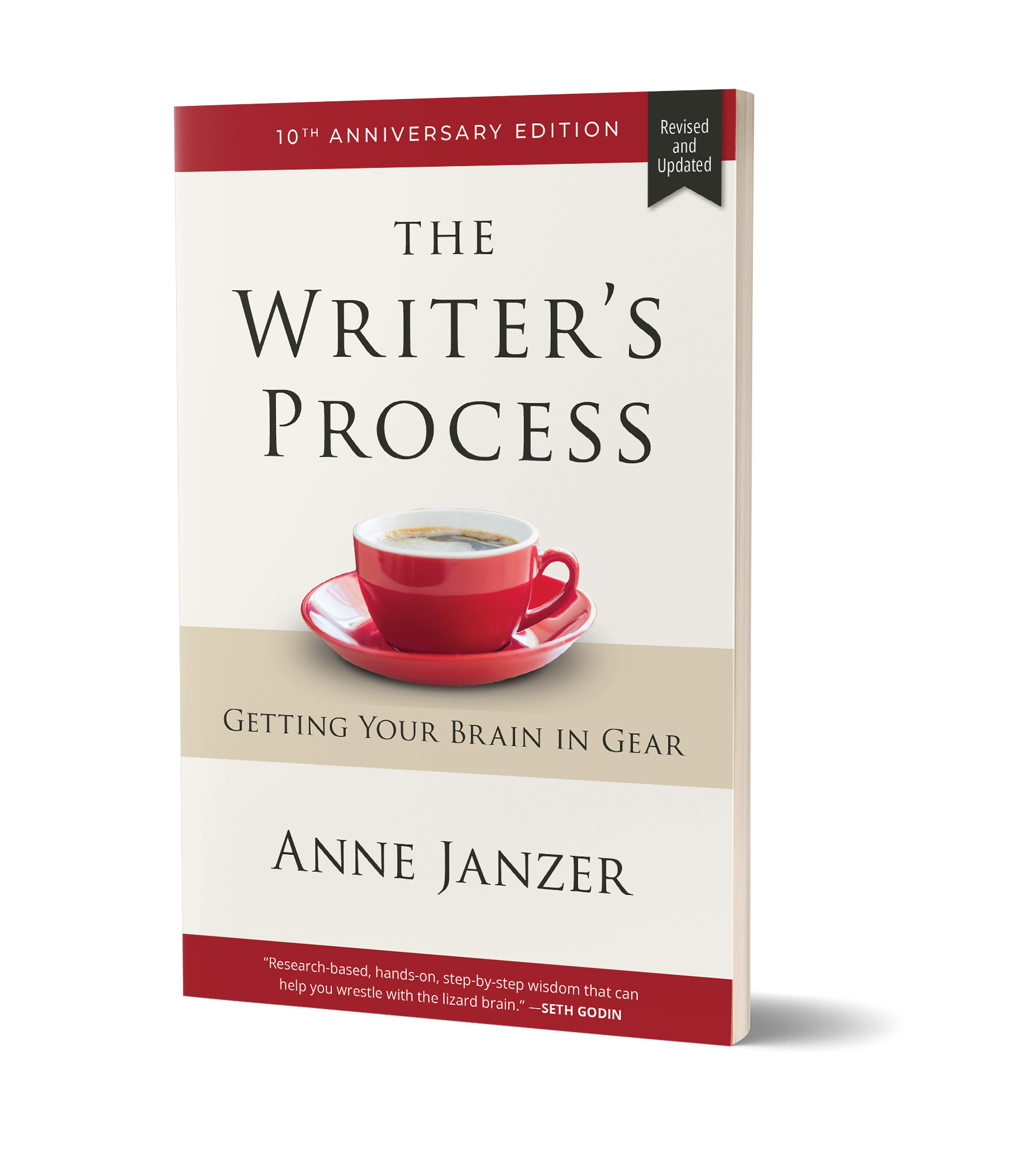
As soon as I started working on it, the changes in my writing voice became apparent. It’s become much more casual—rather like me. And that realization turned this revision into a major undertaking.
I am really proud of this update—it takes everything I loved from the first book and makes it stronger. Revising it was a ton of fun.
What’s new in this edition
If you’ve read the earlier version, you’ll find a lot of new content in this one, including
- New research into creative and flow
- Advice/guidance on integrating AI in the writing process without losing your writing soul or voice
- New experiments to try in your writing life
- A perspective enriched by ten years of coaching, teaching, and, of course writing
What remains constant
The core ideas of the book remain unchanged, including:
- The Muse and the Scribe characters
- The “bread baking” analogy and recipe
- The focus on cognitive science
- A commitment to the very human process of writing!
Not sure if you need the new edition?
If you’re happy with the classic, great! But for its first week, you can get the ebook version (on any ebook platform) for 99 cents or its equivalent in your currency.
That’s a pretty low-risk way to see if you’re interested in the new stuff!
Find the ebook on your favorite retailer.
The paperback version is available on Amazon, Bookshop.Org, or on request from your local bookstore! And for libraries, there’s a sturdy hardcover edition. So, you can ask your library to order it.
If you read it, please let me know what you think! I’m so eager to see it out in the world.
Here’s what the wonderful Roy Peter Clark, author of Writing Tools and Tell It Like It Is, says about the book:
Sometimes good writing — like tap dancing — can seem like magic, a power available only to those with special gifts. In fact, it’s a series of steps, a process available to all. Like a good dance instructor, Anne Janzer shows us the way.”