How carefully do you look at the endnotes in the nonfiction books you read?
I usually skip them—which makes it particularly cruel that they are such a pain to put together.
Of course I want to cite my research. But how best to do that?
- Footnotes are fine for academic works. In most nonfiction, footnotes should only contain conversational digressions that the author doesn’t want to make mandatory. Why clutter up the page with unnecessary stuff?
- Endnotes (at the end of each chapter or the entire book) usually include descriptions of where you found the data you’re citing.
The many flavors of endnotes
Pull a few nonfiction books off your shelf and you’ll probably find different ways of treating endnotes.
Traditionally, endnotes are flagged with superscript numbers in the text, like footnotes. The reader flips to the back of the book to find the reference details. (Most of my books have followed this format.)
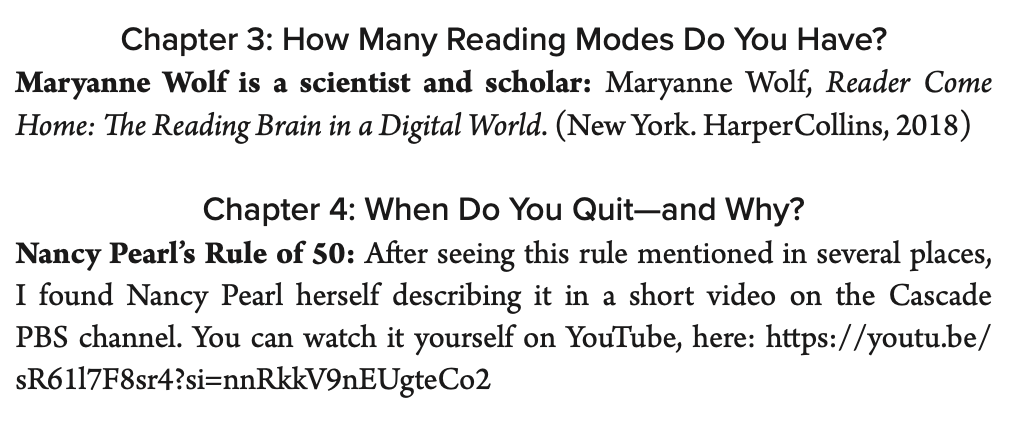
Sometimes books don’t include those superscript numbers. Instead, a Notes section at end of the book lists the references, separated by chapter, with small excerpts from the text indicating where the citation was referenced. This approach does not clutter the reading with superscript numbers.
The Curious Reader’s Field Guide to Nonfiction used that format. Here’s what that looks like:
The problem with endnotes
However you do them, endnotes are a pain. Authors and editors end up spending hours on a part of the book that few people venture into.
Different style guides have precise, and conflicting, ways of formatting endnotes. Authors hate putting them together. Copyeditors hate checking and correcting them.
As you can tell from the excerpt above, I rail against formality. In fact, I just spotted that one of the notes above violates Chicago Manual of Style conventions. Argh.
What I tell my clients
How you handle endnotes depends on the publisher, the audience, and the tone and style of the book.
- For informal books or nonfiction with few citations, it’s probably enough to describe where you found the research in the text.
- If other books in your genre don’t generally do endnotes, you’re probably in the clear. (Find some other way to cite your research.) You can refer to an author or a book in the text without making it an endnote.
- If you’re publishing with a traditional press, they’ll have their own standards for books like yours. Academic presses are probably the most rigorous.
Here’s where I’ve landed on the endnote discussion my own works:
- The endnotes should give the curious reader enough information to find the cited resource.
- I hate to include links because they may disappear, but for some references, links are the only way to go (podcasts, blogs, etc.)
- Notes should be consistent in format and spelled correctly.
I am not going to sweat getting the precisely correct notation for journal volumes, dates, and issues. Why? Because any diligent reader can search for the title of a study and the journal that published it and find a link on their own.
For the next edition of The Writer’s Process, I’ve asked the copyeditor to look for obvious typos and general consistency, without being rigid about exact citation formats.
So, if I’ve muddled the numbers that come after a journal article, I’m assuming you’ll forgive me—if you even bother looking.
